 English











































































































































































































































































































































































































































































































































































































































The Wizard of the Kremlin’ Review: The New Rasputin

History is littered with stories of the man behind the man — the one who was pulling the strings, orchestrating the movements, watching it all happen. Though text at the start of “The Wizard of the Kremlin,” directed by Olivier Assayas, informs us that this film is a “work of fiction with artistic intent,” it is based, in part, on the story of such a man: Vladislav Surkov, a Russian politician and businessman who was a close aide to the Russian president Vladimir Putin until being abruptly dismissed in 2020. Surkov was considered by some to be both an éminence grise in the Kremlin and a spin doctor, manipulating the media to maintain control.
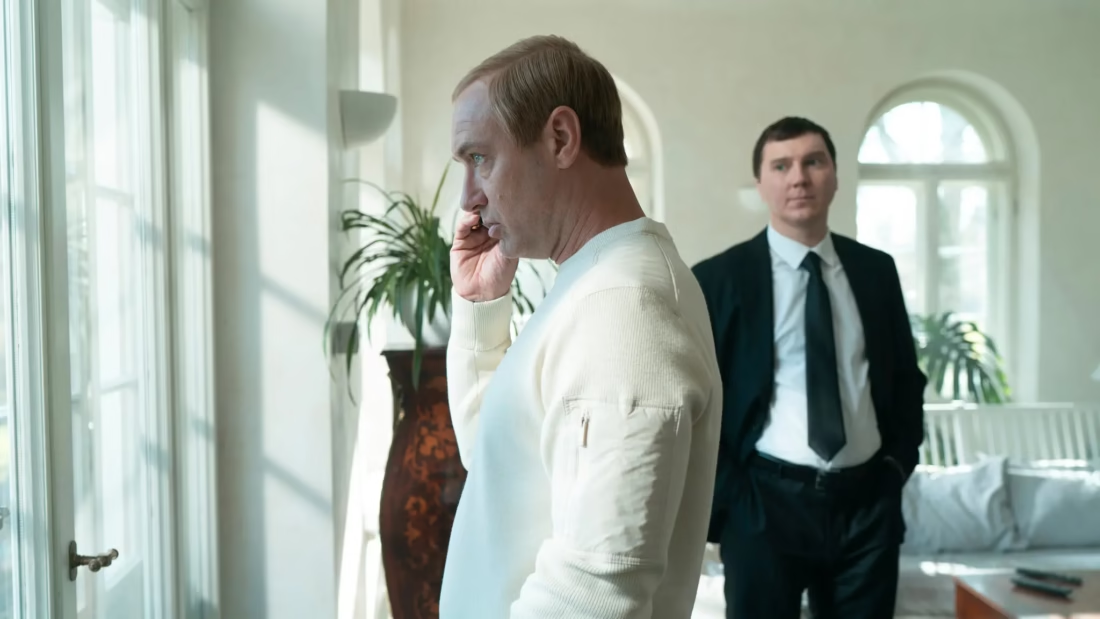
His avatar in this movie is Vadim Baranov (Paul Dano), a man with a gentle demeanor and sophisticated taste in art and literature. The screenplay, which Assayas wrote with Emmanuel Carrère based on Giuliano da Empoli’s 2022 novel, introduces us to Baranov via an American journalist and scholar of Russia named Lawrence Rowland (Jeffrey Wright). Rowland has written an article about Baranov in Foreign Affairs magazine — “Vadim Baranov and the
Invention of Fake Democracy” — and it seems to have attracted the attention of Baranov himself. While in Moscow in 2019, Rowland exchanges messages over social media regarding the 1924 proto-Orwellian novel “We,” by the Bolshevik writer Yevgeny Zamyatin, with a person he does not know. Accepting his correspondent’s invitation to talk in person, he travels to their country home, and discovers that it is Baranov himself.
From there, “The Wizard of the Kremlin” largely takes the form of a story within a story. Baranov walks Rowland through his life, explaining what Rowland got right and what he got wrong in his article, though it feels as if Baranov is rummaging back over his life looking for the answer to a question he can’t quite articulate to himself.
It begins with Baranov’s student days in the early 1990s, in the heady “new Russia,” just after Soviet communism had collapsed. Everything felt possible and money flowed freely. As Baranov recalls it, those days felt like a never-ending bash, or maybe an orgy, where you might watch a naked man on a leash follow a punk rock singer around at a house party. As an avant-garde theater student and then director, Baranov lived a life of art and poetry with his girlfriend, Ksenia (Alicia Vikander). When the vulgar but fun Dmitri Sidorov (Tom Sturridge), the inventor of Russia’s first commercial bank, enters their lives, things grow brighter, then more sour.
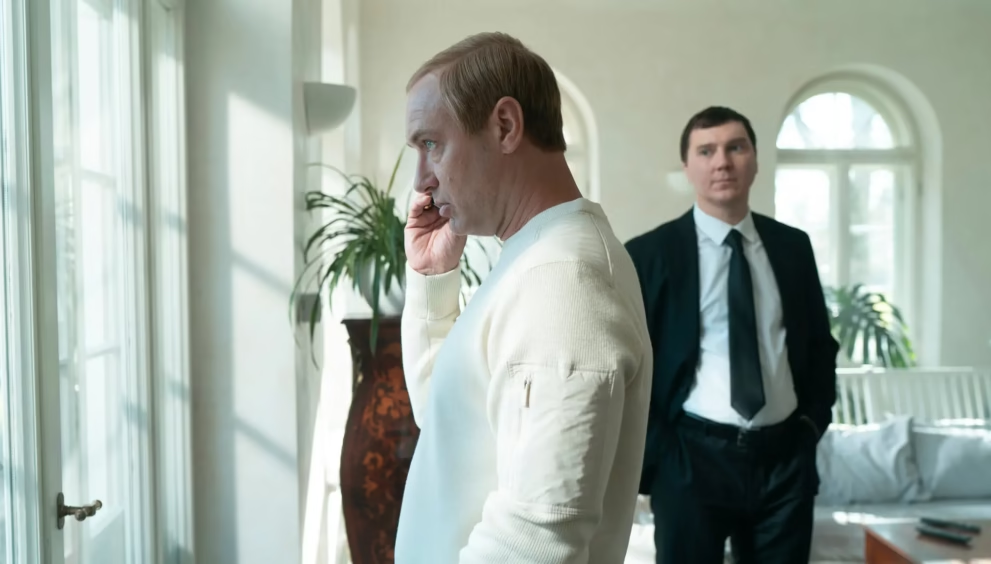
But Baranov moves on, taking a job in trashy reality television production, and this is where the historical tale begins to take shape. “The Wizard of the Kremlin” is really a movie about how Russia went from those heady post-Soviet days to the rise of the oligarchy to, eventually, the establishment of Vladimir Putin (a mostly chilling Jude Law) as president, a former K.G.B. officer who valued power over money. The oligarchs who choose Putin as Boris Yeltsin’s successor realize too late that this man will not be their pawn. “What interests me is restoring integrity to the Russian Federation,” he tells Baranov. And that means consolidating power — in himself.
Baranov, with his talent for weaving a story, is useful to Putin, and at this point he has little idealism left. As he grows nihilistic, believing that truth is whatever he wishes to make of it, so does his country. A background in theater and reality TV proves useful: He turns out to be a communications genius, figuring out how to manipulate political theater to not just represent reality, but invent it. They call him “the new Rasputin.”
As you may already have surmised from the casting, “The Wizard of the Kremlin” is not in Russian; the actors speak in English, which suggests this is an account of Russian history intended for non-Russian audiences. Even with its 136-minute running time, that’s a lot of ground to cover, so it moves at a good clip. This has an interesting dramatizing effect: We see history progress through Baranov’s eyes in broad arcs, and figures like Putin, who often occupy daily headlines, become more like characters in a play.
And while that can result in the oversimplification of a person, it can also be useful when trying to figure out why a person does the things they do. In a play or a movie, people have roles, psychological traits and motivations that drive their character arcs. Here, the lightly fictionalized version of an authoritarian is driven not by the desire for something like money, like the oligarchs, but by the desire for power. Projecting an image of strength is part of that desire; propaganda is the means by which one does this.
It’s a useful framework for understanding leaders around the world, and Baranov is the ideal cipher, someone who intimately understands how easily people’s minds are swayed and molded. That peek behind the curtain is the greatest strength of “The Wizard of the Kremlin,” and also its scariest element: The notion that in an age where truth can be manufactured, the people doing the manufacturing hold so much of reality in their hands. But even they can also be tossed aside when they stop being useful to the powerful. And then what was the point of all that wizardry?
The New York times